Back to Projects

Malware Detection
with CNNs

Deep Learning reproduction study classifying malware instances by converting binaries into images and analyzing them with Convolutional Neural Networks.

Python Deep Learning Nested CV
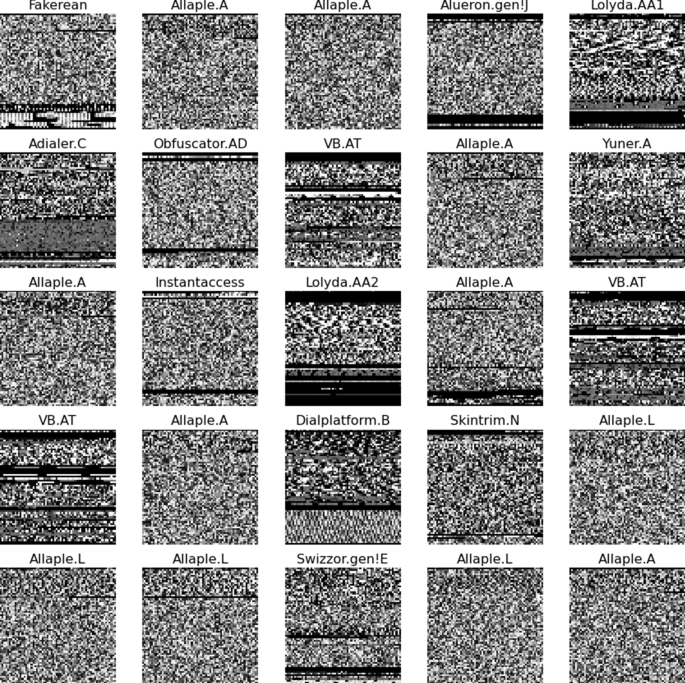
Malware Binary Images

01. The Concept

Malware binaries can be visualized as grayscale images, where differences in code structure reveal distinct visual textures. In this project, we reproduced the methodology from the paper "Using convolutional neural networks for classification of malware represented as images" [1].

The goal was to achieve high classification accuracy on the Malimg dataset by optimizing the CNN architecture using rigorous nested cross-validation to prevent overfitting during hyperparameter tuning.

02. Technical Deep Dive

Hyperparameter Tuning Results

We explored various architectures, varying the number of convolutional layers, feed-forward layers, and kernel sizes. The best performance was achieved with a 3-layer CNN architecture.

Conv Layers Test Accuracy Test MAE Std. Dev.
4 97.27% 0.30 0.017
3 (Best) 98.62% 0.07 0.004
2 98.52% 0.07 0.009

* Results obtained via 10-fold nested cross-validation on the Malimg dataset.

Results & Impact

  • Successfully reproduced paper results (>98% Acc)
  • Validated improved stability with Nested CV
  • Trained on large-scale dataset (~147GB)

Project Context

Academic reproduction study focusing on robust model evaluation techniques in Deep Learning. Code structure emphasizes modularity and reproducibility.

#ComputerVision #CyberSecurity